Verteporfin and Hair Transplantation: What We Know, What We Don’t Know, and What We’re Testing
What Is Verteporfin?
Historically known by the brand name Visudyne, verteporfin is an FDA-approved medication used with photodynamic therapy for certain abnormal blood vessels in the eye, including those associated with some forms of macular degeneration. Its use in wound healing or hair restoration is investigational and off-label.
More recently, researchers have studied verteporfin for a very different reason: its ability to inhibit YAP-associated mechanotransduction, a signaling process involved in fibroblast activation and scar formation.
Verteporfin for scar-less wound healing
When adult skin is wounded, mechanical tension can activate YAP (Yes-associated protein) signaling in fibroblasts. This signaling can promote a transition toward scar-forming fibroblasts and the deposition of fibrotic tissue.
Scar tissue restores the integrity of a wound, but it differs from normal skin in collagen architecture and may lack normal skin appendages such as hair follicles and glands. This distinction is central to the scientific interest in regenerative wound healing.
The Stanford Discovery: Reimagining Healing
Research led by Dr. Michael Longaker’s team at Stanford University examined whether interrupting this mechanotransduction pathway could change the way wounds heal.
In mouse studies published in Science in 2021 and Cell Stem Cell in 2022, verteporfin was used to inhibit YAP signaling in fresh wounds. Compared with control wounds, verteporfin-treated wounds showed reduced fibrosis and a more regenerative pattern of healing, including recovery of hair follicles, glands, more normal extracellular-matrix architecture, and mechanical strength.
These findings are compelling, but they remain primarily preclinical. Whether the same degree of regeneration can be achieved safely and consistently in human scalp wounds is not yet established.
Verteporfin for hair regeneration
For hair restoration, the key question is especially important: if YAP inhibition can reduce fibrosis and permit hair-follicle regeneration in animal wounds, could localized verteporfin improve healing after hair-transplant donor harvesting and possibly allow follicular structures to regenerate in human scalp?
The potential applications include reducing fibrosis after FUE punch extraction and improving healing of FUT donor incisions. Small human case reports and exploratory clinical use have generated interest, but they do not yet establish effectiveness. Controlled human studies are needed before claims of donor hair regeneration or scarless hair transplantation can be made.
verteporfin study at Parsa Mohebi Hair Restoration
To help answer these questions, our team at Parsa Mohebi Hair Restoration designed Project V, building on the Stanford preclinical work and early human experience reported by hair-restoration physicians, including published work by Dr. Melissa Toyos. Our goal is to evaluate how locally administered verteporfin affects FUE donor-site healing, scarring, and the possibility of hair regeneration.
Project V is structured as a prospective, multicenter pilot study using an intra-subject control design. Each participant serves as their own control, helping reduce the effect of differences in genetics, skin characteristics, and individual healing.
How the Study Works
- Participants: 10 patients across participating research sites, followed for 12 months.
- Donor Mapping: Two matched boxes are marked on the donor scalp and separated by a 2 cm buffer zone. A small tattoo reference point supports consistent follow-up photography.
- Extraction: Exactly 50 hair grafts are harvested from each box using the same FUE technique.
- Targeted Injections:
- Treatment Box: Receives a standardized local injection of verteporfin.
- Control Box: Receives a matched injection of balanced salt solution (BSS).
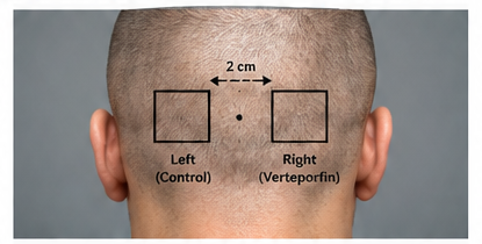
Two symmetrical extraction boxes are separated by a 2 cm buffer and positioned around a fixed reference point.
What We Are Measuring
Participants return for follow-up at 1, 2, 3, 6, and 12 months. At each visit, the test areas are shaved and photographed under standardized conditions to evaluate:
- Hair Density: Hair counts per square centimeter and changes that may suggest follicle preservation or regeneration.
- Scarring and Visibility: Scar appearance, texture, redness, and other standardized clinical measures.
- Healing and Safety: Skin recovery, hair retention, and local adverse effects.
Why Controlled Testing Matters
Human scalp healing is not identical to healing in animal models. Without a matched control area in the same patient, it can be difficult to separate the effect of verteporfin from surgical technique, baseline hair density, photography, or natural healing. Project V is designed to produce objective comparative data before conclusions are drawn.
Current Status
Project V is moving through pharmaceutical sourcing and clinical setup, with patient enrollment planned to begin shortly. Verteporfin is not FDA-approved for hair regeneration or scar prevention, and participation in this study involves investigational, off-label use.
Unanswered Questions and Looking Ahead
Important questions remain, including the optimal local dose, concentration, injection depth, timing, safety, and whether the regenerative effects seen in animal models will translate to human scalp tissue. Verteporfin is also light-sensitive, and commercial formulations are supplied in quantities designed for ophthalmic use rather than small local wound injections, creating practical handling and sterility considerations.
Project V was designed to address these uncertainties with side-by-side controlled observation. Our objective is not to assume that verteporfin regenerates donor hair or eliminates scarring in humans, but to test whether a measurable biological and clinical difference exists.
Interested in Following or Participating in Project V?
If you would like updates on Project V or want to learn whether you may qualify for participation in our clinical research, contact the research team at Parsa Mohebi Hair Restoration:
- Email: Research@parsamohebi.com
- Website: www.parsamohebi.com
- Phone: 818-788-8363
References
- Mascharak S, et al. Preventing Engrailed-1 activation in fibroblasts yields wound regeneration without scarring. Science. 2021;372(6540):eaba2374. doi:10.1126/science.aba2374.
- Mascharak S, Talbott HE, Januszyk M, et al. Multi-omic analysis reveals divergent molecular events in scarring and regenerative wound healing. Cell Stem Cell. 2022;29(2):315-327.e6. doi:10.1016/j.stem.2021.12.011.
- Toyos M, Toyos R, Toyos A. Use of Verteporfin to Regrow Hair and Reduce Fibrosis after Transplantation. J Dermatol Res Ther. 2025;11:131. doi:10.23937/2469-5750/1510131.
- Scott LJ, Goa KL. Verteporfin. Drugs Aging. 2000;16(2):139-148. doi:10.2165/00002512-200016020-00005.
- Chen F, et al. Repurposing verteporfin and hyaluronic acid gel for ocular surface treatment to prevent corneal scarring. J Control Release. 2025;380:1141-1151. doi:10.1016/j.jconrel.2025.02.051.